
AI Reshapes India’s IT Services Industry as Clients Demand More for Less
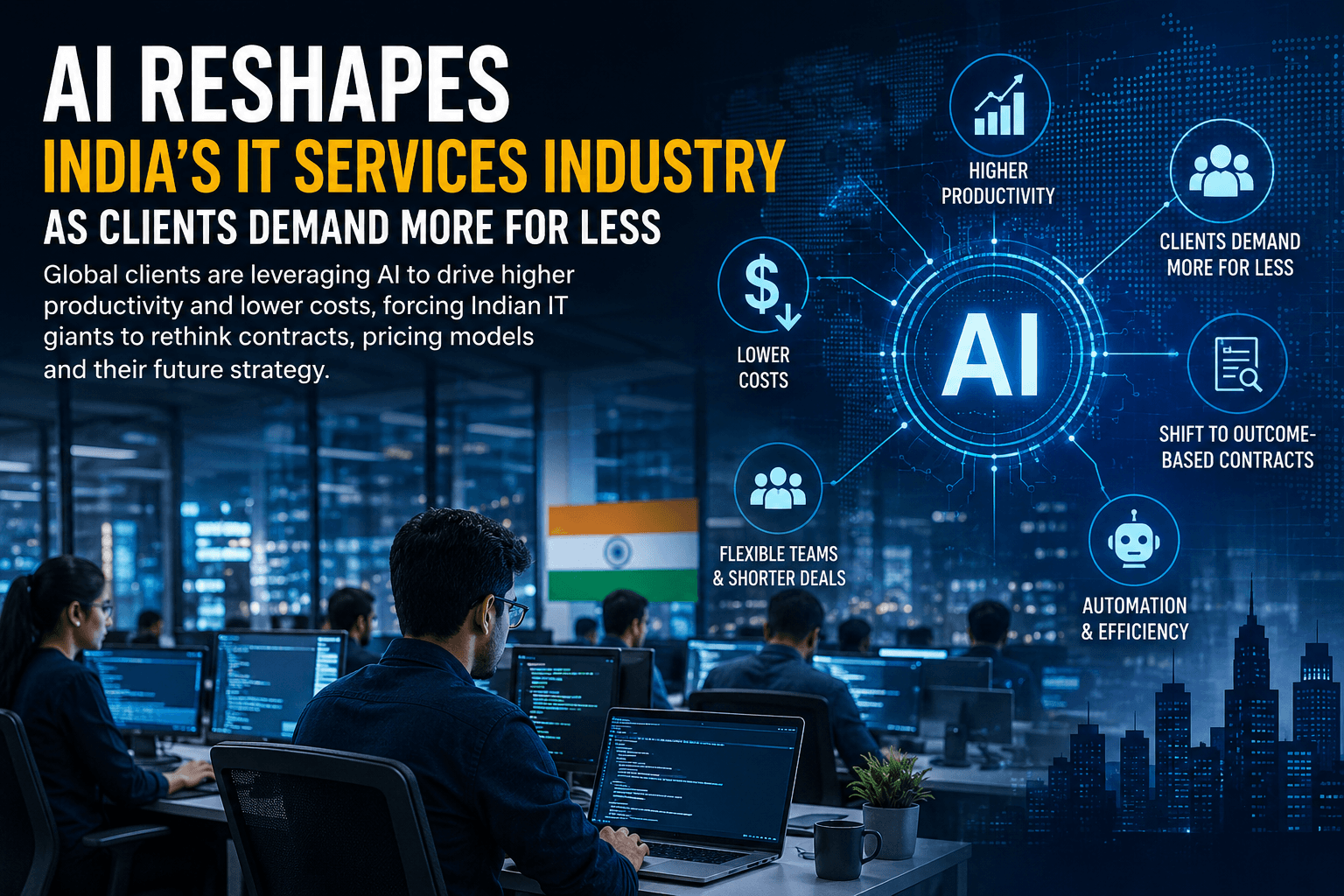
India’s technology services giants are facing a major shift in the way they win, price and deliver contracts as artificial intelligence changes what global clients expect from outsourcing partners.
India’s $300-billion-plus IT services industry is entering a new phase. For decades, the sector’s growth was built around a familiar model: companies hired large teams of engineers and charged clients based on the time and resources required to complete projects.
Artificial intelligence is now challenging that model.
Global clients are increasingly asking Indian IT service providers to deliver more work at lower costs, using AI-driven productivity gains to reduce the number of hours and people required for certain tasks. As a result, major outsourcing companies are beginning to rethink how contracts are priced and structured.
Companies across the industry, including Tata Consultancy Services, Infosys, Wipro and HCLTech, are facing pressure to move beyond traditional time-and-materials contracts and focus more on outcome-based agreements.
From Billing Hours to Delivering Outcomes
The biggest change could be in the way IT companies make money.
Traditionally, clients paid technology service providers based on the number of employees working on a project or the hours spent delivering services. AI has made many coding, testing, customer support and back-office processes faster, raising an obvious question for clients: if technology can complete the same work more efficiently, why should they pay the same price?
This is pushing service providers towards contracts linked to business outcomes, productivity improvements and measurable results rather than simply the size of a team.
For Indian IT companies, this creates both an opportunity and a challenge. Companies that successfully use AI to improve efficiency could potentially increase profitability. However, clients are also demanding a share of those productivity gains through lower prices.
The result is likely to be a tougher negotiation environment across the outsourcing industry.
Some Work Is Moving Back In-House
AI is also allowing some companies to bring certain technology tasks back inside their organisations.
Work that previously required external development teams can now, in some cases, be completed by smaller internal teams using AI-powered tools. This has increased uncertainty around the size and duration of outsourcing contracts, with businesses reportedly opting for shorter agreements in some cases.
That does not necessarily mean the end of IT outsourcing. Large enterprises still need technology partners for complex digital transformation projects, cybersecurity, cloud infrastructure and enterprise-scale systems.
However, the type of work being outsourced may change significantly.
Routine tasks could become increasingly automated, while demand may grow for companies with deeper expertise in AI integration, data systems, cybersecurity and industry-specific technology solutions.
Indian IT Companies Face a Strategic Reset
The AI shift comes at a crucial time for India’s IT industry. The sector remains one of the country's most important exporters and employers, but growth has become more challenging as global companies reduce discretionary technology spending and look for greater efficiency.
Recent industry activity suggests that IT companies are already adapting their strategies. Acquisitions, investments in AI capabilities and efforts to move into higher-value technology services are becoming increasingly important as companies look beyond traditional outsourcing models.
The challenge for Indian IT firms will be to prove that AI is not simply a tool that reduces the value of their services, but one that enables them to deliver more valuable solutions to clients.
A Bigger Change Than a Technology Upgrade
The impact of AI could ultimately go beyond productivity.
For years, India’s IT industry benefited from its ability to provide skilled technology talent at scale. In the AI era, scale alone may not be enough. Clients will increasingly look for partners that can combine technology expertise with measurable business outcomes.
This could reshape hiring patterns, pricing models and the skills companies prioritise.
While concerns remain about AI reducing demand for certain entry-level technology roles, the transformation could also create new opportunities in areas such as AI engineering, data management, cybersecurity and technology consulting.
The next few years may determine which companies successfully make that transition.
The Bottom Line
Artificial intelligence is forcing India’s IT services industry to answer a difficult question: what is the value of an outsourcing company when technology can do more of the work?
The answer may lie in moving from selling manpower to delivering business results.
For India's IT giants, AI represents both a threat to traditional revenue models and one of the biggest opportunities in decades. Companies that adapt quickly could emerge stronger and more efficient. Those that continue relying on older ways of pricing and delivering services may find it increasingly difficult to compete.
The transformation has already begun, and the effects are likely to be felt across India's corporate and employment landscape in the years ahead.